Serving the Invisible Middle Takes a Healthcare Ecosystem
Here’s an uncomfortable truth about early disease detection: the last thing our healthcare system needs right now is more patients.
That’s a strange thing to hear from a CEO whose company finds undiagnosed patients for a living. But it’s the problem we must solve. Finding patients only creates value if there’s a scalable way to move them from identification to diagnosis, and from diagnosis to care. Otherwise, we’ve just created more demand for a system that’s already maxed out.
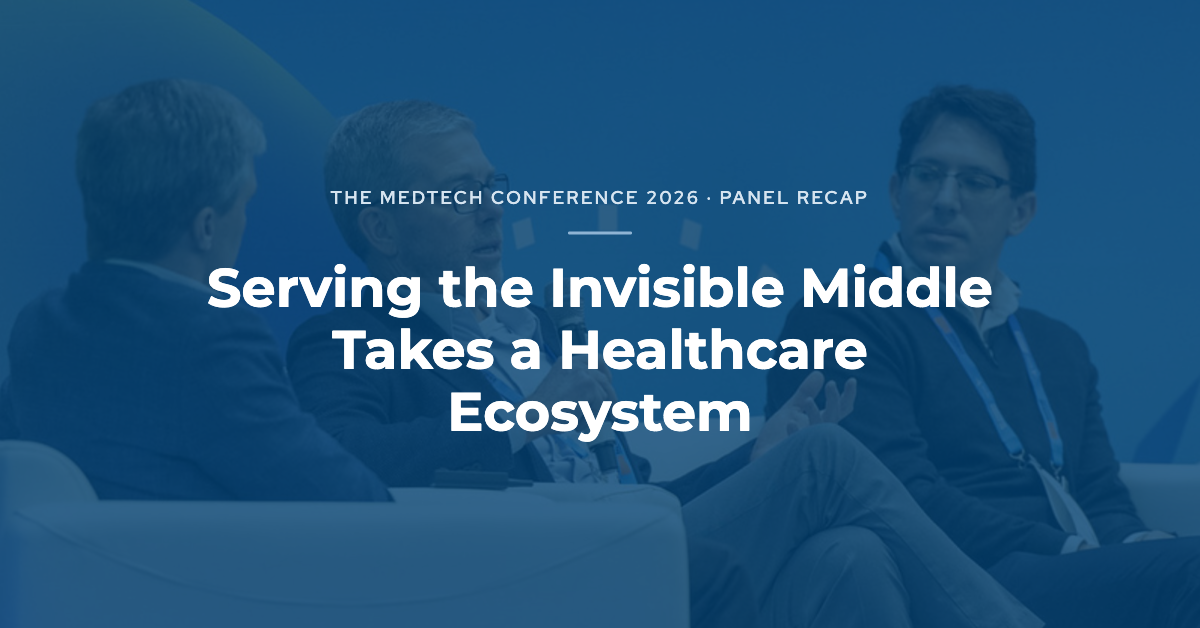
I got to dig into this on a panel with Quentin Blackford of iRhythm, Dr. Jeff Wessler of Heartbeat Health, and Dr. Xiaoyan Huang of CenterWell, moderated by Dr. Justin Klein of Vensana Capital. Our assignment was to look beyond the device and show how ecosystems and partnerships multiply value. Justin pushed us to make the value story “real.” For example, what difference does it make for patients? As the non-clinician software guy in a room full of clinical heavyweights, I was a bit of a fish out of water. So, we skipped the theory and walked through a real scenario.
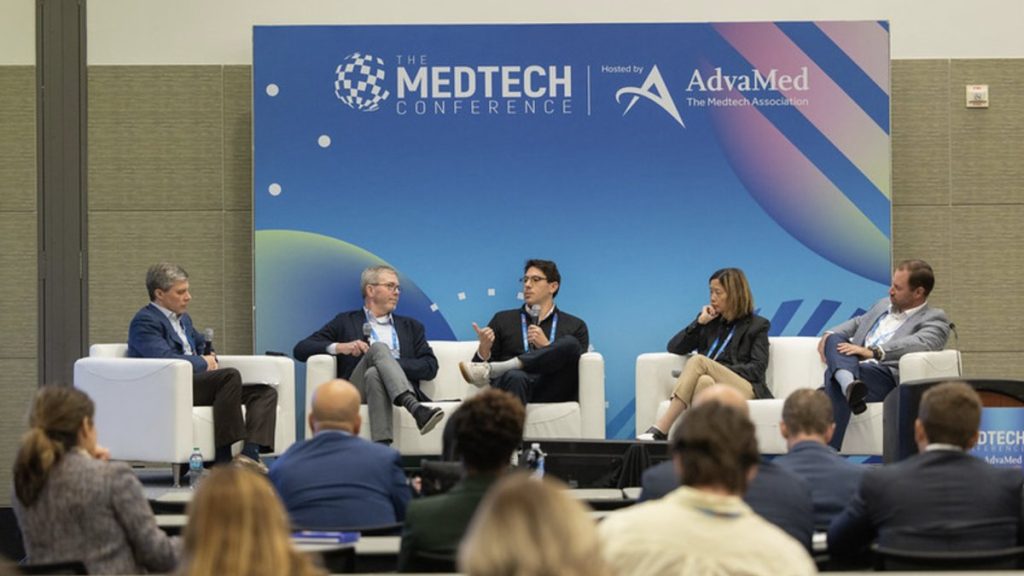
The “Beyond the Device” panel at The MedTech Conference 2026. Left to right: Dr. Justin Klein, Vensana Capital (moderator); Sean Cassidy, Lucem Health; Dr. Jeff Wessler, Heartbeat Health; Dr. Xiaoyan Huang, CenterWell; and Quentin Blackford, iRhythm.
The Invisible Middle
We started by framing the opportunity and the challenge. The opportunity lies within a vast population of underserved patients with undiagnosed diseases. At Lucem Health, we call this population the “Invisible Middle.” Helping healthcare providers identify, engage, diagnose, and treat this population is all we do. Our passion (which I may have gotten a little preachy about on stage) is using technology to accelerate their path to treatment so we can change their outcomes and even save lives. Earlier identification can help us find patients before disease progresses. The harder question is what happens after we find them.
The challenge is serving this population at scale, and that, more than anything else, was what we ultimately focused on.
Identify → Test → Confirm → Route → Treat
Addressing the challenge is where healthcare ecosystems and partnerships come in. iRhythm, Heartbeat Health, and CenterWell all focus on cardiology and better cardiac care, and Lucem Health happens to be rather good at early identification of arrhythmias. We “made it real” for the audience by walking through a scenario that showed how a group of seemingly disparate ecosystem participants could create a compelling, scalable path from identification to treatment for cardiac patients in the Invisible Middle.
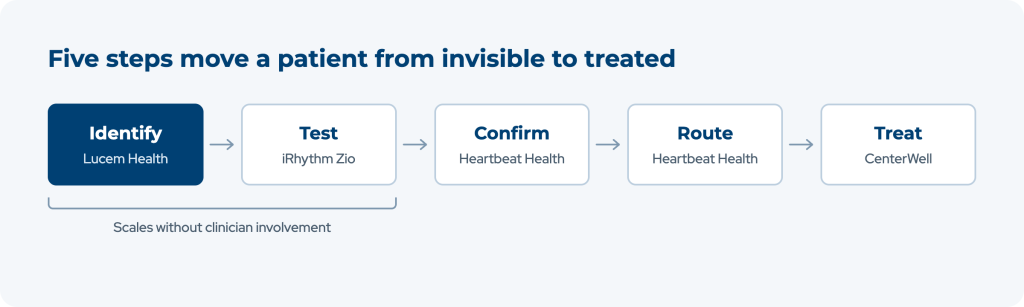
Identify. I went first and described how Lucem Health Reveal for Arrhythmias uses commonly available data from EHRs, along with powerful AI technology, to identify patients who may have undiagnosed arrhythmias. I also shared how critical it is to inspire action in patients whom we identify. If we can’t get patients to commit to the next step (more on that in a sec), then it’s all for naught. I made the point that any ecosystem we construct to serve the Invisible Middle must include patients as a critical stakeholder (cut to a visual of heads nodding and the sound of pencils scribbling).
Test. Quentin went next. He shared how iRhythm takes the patients we’ve identified and engaged and sends them a Zio long-term continuous cardiac monitor (basically, a thin, lightweight patch with a sensor that patients can apply to themselves at home). Patients wear the monitors for up to 14 days and send them back to iRhythm, which then reads the continuous, uninterrupted ECG recordings and produces comprehensive end-of-wear reports.
Notice that clinicians are not yet involved in this process. So far, it scales more or less infinitely.
Confirm. But reports are not diagnoses and diagnoses are not treatments. That’s where Jeff’s team comes in. Heartbeat Health employs licensed clinicians in all 50 states and can augment cardiology capacity for healthcare providers, which is a big deal given how short we are on cardiologists. Heartbeat does many things, but, in this example, Jeff shared how they can take iRhythm’s end-of-wear reports and determine whether patients do indeed have arrhythmias. They can then determine the appropriate next steps, which may involve telehealth visits, referrals, or no actions at all.
Route. Plot twist: some patients can be served completely by Heartbeat, which is great for scale. However, some may actually require in-person interactions with clinicians.
Treat. CenterWell provides primary care, home health, and pharmacy services for seniors. While they do not have a cardiology specialty footprint, Xiaoyan reminded us that many arrhythmia patients can be seen, and treated, within primary care. She described the huge scaling role primary care can play in taking the pressure off cardiology service lines, enabling cardiologists to practice at the top of their licenses more often. Talk about a hot take.
That’s more or less the end of our story. Nobody was checking their phone (that I saw), so I’m hopeful we made the case that the right healthcare ecosystem can actually reach the Invisible Middle at scale.
This Was Never Really About Cardiology
But wait, there’s more…
As my wife will tell you, I usually have to have the last word, so I saw my opening at the end of the conversation and took it. I made the point that, while we had spent the last hour talking about a cardiac care example, cardiology simply gave us a useful way to make the concept real. The same challenge exists in Type 1 Diabetes, kidney disease, rare cancers, and countless other conditions.
Earlier identification is important, but it is only the beginning. The real opportunity lies in creating scalable pathways that help patients move from identification to diagnosis, diagnosis to treatment, and ultimately, to better outcomes. That is why I find ecosystem thinking so compelling.
Further Reading
For more on the patients our healthcare system often misses, read Sean’s original viewpoint in Chief Healthcare Executive: The Invisible Middle Is Healthcare’s Biggest Missed Opportunity.
For a look at how earlier identification applies to kidney disease, read Kristy Drollinger’s perspective: Early Chronic Kidney Disease (CKD) Identification: Why It Makes Strategic and Financial Sense for Health Systems.